



What are progressive jackpots? How casino prize pools actually work
Table of Contents
Watch the prize meter beside a slot for several minutes, and it may move even when you are not playing. What are progressive jackpots in practical terms? They start at a seed value and grow under the game’s rules, then the meter resets after a qualifying win. The displayed amount is not a prediction of when the payout will happen. It shows the current value available if the jackpot triggers at that moment.


At our ToonieBet online casino, progressive online slots sit alongside fixed-jackpot games, where top prizes do not increase between spins. Knowing which format you have opened affects how you read the paytable and decide whether the required stake, should there be one, fits your budget.
Beyond the Standard Spin: What Exactly Is a Progressive Jackpot?
Fixed jackpot online slots may pay 1,000x the stake size or more whenever the top combination lands, or when one of the jackpots is awarded in another way. On the other hand, progressive games add a separate pool, with a portion of all qualifying wagers being allocated to it. This pool starts with a seed value rather than zero, so a stated amount remains after a win resets the meter, before the next wagers contribute towards it growing once again.
It’s also possible for more than one progressive jackpot to run at the same time. Labels such as Mini, Minor, Major, and Grand can split up these different pots, all featuring their own starting values or trigger conditions. There are also network progressive jackpots, which means that the same potential winnings pot is used across multiple titles.
Understanding how progressive jackpots work requires separating the growing prize from the event that awards it. An RNG determines the spin result according to the mechanics of the game, while the meter simply records the current jackpot value. More wagers across the linked game(s) can make the number rise faster, however, a larger meter does not make an individual spin more likely to trigger the jackpot.
Before staking real money, open the game rules for your desired slot and confirm the following:
- The minimum qualifying stake and whether every wager level can access the top pot.
- The trigger, including any required symbols or separate jackpot feature.
- Whether the displayed meter is exclusive to that title or shared with other casino games.
- The current RTP rate and the volatility of the slot.
That check takes less time than one extended slot session and prevents a basic error that many players encounter, which is spinning at an ineligible stake size while assuming they are still contributing to the jackpot trigger.
The Three Tiers of Progressive Jackpots
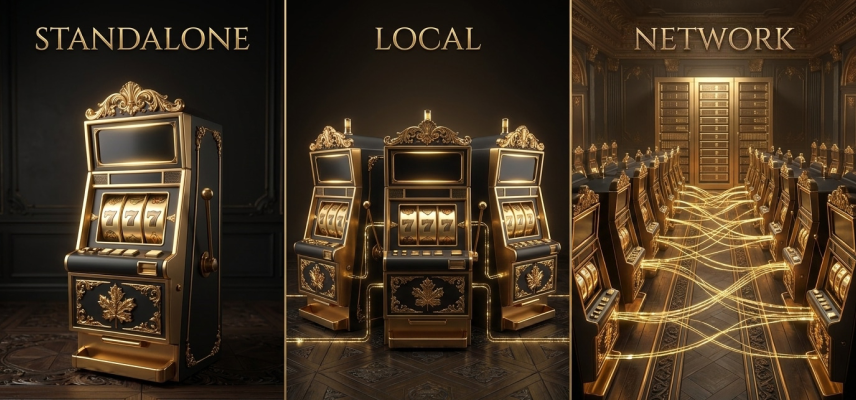
The pool size of a progressive jackpot heavily depends on how many qualifying wagers feed the same pot. For example, a title taking wagers from one game will usually accumulate money more slowly than a pot shared across numerous casinos. While fast-growing pots can reach higher values before they’re awarded, it’s important to remember that more players have the chance to trigger the same prize.
Here are the most common progressive jackpots and their key characteristics:
| Jackpot Type | How The Pool Grows | Typical Prize Potential |
| Standalone | Qualifying wagers on one game or game instance contribute to its own meter. | Usually the smallest progressive pool because it has the smallest contribution base. |
| Local | A selection of eligible games within one casino or provider feed a shared pot. | Can exceed a standalone prize while remaining limited to that local player pool. |
| Network | Connected games across multiple participating casinos contribute to one pool managed by the same provider. | Has the greatest capacity to reach higher amounts because the contribution base is broader. |
Standalone does not mean fixed because its value still rises, but all eligible contributions come from one game. Fewer competing players may sound appealing to players, yet the odds cannot be assessed without carefully checking the game rules.
Local progressives connect activity inside the same environment. Online versions can link eligible titles across one operator rather than a row of physical machines on one casino floor. Trigger rules can differ between operators, so check the game information before starting.
Often with the highest values displayed, network jackpots combine qualifying play from participating sites and can accumulate beyond what one casino would normally generate. This scale affects the amount available, but does not increase the players’ chances as a result.
The Mechanics of Winning: How Do You Actually Trigger the Pot?
No universal symbol combination unlocks every progressive jackpot. Each supplier offers a trigger and lists the qualifying conditions in the game information, so the rules visible inside the title are what players should always check to determine how a jackpot is awarded.
So, how do progressive jackpots work at the point of a winning spin? In simple terms, the RNG selects an outcome. The game then checks wager eligibility before the supplier validates the event. A successful result can occur on a base-game spin or inside a feature, and once confirmed, the pool is awarded under the terms of the title.
There are plenty of unique triggers in jackpot games created by providers, but some of the most common ones include:
- PaylineTrigger: A specified combination of jackpot symbols must land on an active line.
- FeatureTrigger: Qualifying symbols open a wheel, pick screen, respin round, or another dedicated jackpot round.
- MysteryTrigger: The game awards a jackpot through an RNG event that can occur independently of a normal reel win.
- Must-drop Trigger: The pot must be awarded before a stated value or deadline defined in the rules. If one of these is present, the time remaining is normally shown on the tile in the progressive jackpots area at ToonieBet.
With all of these types of trigger, higher stakes do not automatically improve the jackpot odds. Some games make every permitted wager eligible but scale the probability or prize share with the stake, while others impose separate conditions that players must meet to become eligible. One of the games you can find at ToonieBet, Age of the Gods: God of Storms, for example, uses four linked progressive prizes that can trigger independently of the base-game result.
Another thing to remember is that real-money eligibility for players also matters. Enjoying a demo mode can help you to understand the reels and bonus features, if any, but it cannot deliver a withdrawal jackpot amount. Some progressive jackpots also cannot be awarded when using bonus funds, so check the active promotion terms before you jump in.
The Hidden Cost: RTP and High Volatility

The large jackpot meters mean that part of a game’s potential return occurs through an outcome that is extremely rare, which helps to explain why progressive slots can feel less forgiving during ordinary play, even when the RTP is close to another title’s. This is because RTP is a long-run theoretical percentage calculated over a very large number of spins, with the potential jackpot winnings being factored into this.
Let’s say a slot has a theoretical RTP of 95%. This means that by using its underlying model, the expected long-run return is $95 for every $100 wagered, but one player can lose the full amount while another finishes far above it. The jackpot forms part of that theoretical return in many slots, which is why the base game can seem slower. With that being said, many games will display the RTP without jackpot contributions, too, which can be a useful statistic for players to assess.
As for volatility, this describes the distribution of potential winnings. A high-volatility progressive can produce long stretches with limited returns because more value is concentrated in rarer outcomes. Raising the stake to chase a climbing meter increases the amount exposed per spin, while the house edge still applies across repeated play. No meter is “due” simply because it has not been awarded recently, and likewise, a reset jackpot is not “colder” than the same game at a larger value, unless the rules state otherwise.
When comparing slots, things to look at include:
- Compare RTP using the exact versions available in our catalogue.
- Check whether the top jackpot requires a minimum stake or optional side bet.
- Divide the session budget by the intended stake to estimate the maximum number of rounds.
- Treat the rising meter as information only, not evidence that a win is approaching.
Stopping at a preset budget is more reliable than extending play because the jackpot has moved closer to a personally appealing number.
A Brief History of Massive Wins
Slots with linked progressive jackpots have changed the scale of slot prizes by pooling wagers beyond just one machine. These were created in 1986, and there have been plenty of massive wins since their inception:
- 1986: IGT launched Megabucks, which was the world’s first wide-area progressive jackpot system.
- 2003: A 25-year-old software engineer won US $39,713,982.25 on Megabucks at the Excalibur in Las Vegas after spending about $100 spinning the reels. Guinness World Records has this as the largest physical slot-machine win of all time.
- 2013: An anonymous player in Finland won €17,861,813 on NetEnt’s Mega Fortune, setting the online slot record at that time.
- 2015: Jon Heywood won €17,879,645 on Microgaming’s Mega Moolah. Guinness has this as the largest jackpot payout in an online slot-machine game.
Those figures are historical records, not typical outcomes or estimates of a current ToonieBet prize. Currency and payout arrangements also differ between examples. The meter inside our lobby is the figure to look out for, while the rules determine what wagers are eligible. Keep in mind that past jackpots do not have any influence over the next result, as each spin is totally independent.
Frequently Asked Questions About Progressive Jackpots
1 Where to Play Progressive Jackpots?
Players can find progressive titles in our jackpot games section at ToonieBet. We also have fixed jackpot slots alongside many other casino games.
2 How Are Progressive Jackpots Paid Out?
After a trigger, the result is often verified before the amount becomes available for withdrawal. Online winnings are normally credited to the player’s account, and a withdrawal can then be requested through the available methods, subject to account verification and transaction limits.
3 Does a Larger Progressive Jackpot Improve My Odds?
No, the prize can keep growing while the probability attached to an eligible spin remains unchanged.
4 Must I Use the Maximum Bet to Qualify?
No, you don’t always have to use the maximum bet to qualify, unless the game rules say otherwise. Some titles keep players eligible for all stake sizes, while others may require a minimum qualifying amount or an optional jackpot wager. This is why checking the rules before you play is important.
5 Can I Play Progressive Jackpots With Bonus Funds?
Some progressive jackpots can be played with bonus funds, depending on the exact game and active promotion. To find out whether this applies to the title you want to play, read the promotion terms first and look out for restricted titles or game types, as an excluded game may fail to advance wagering or breach the bonus rules.
The content is provided for general informational and entertainment purposes only and does not constitute betting advice, financial advice, or a recommendation to place any wager. Odds are subject to change. Sports wagering involves risk, and there is no guarantee of success or profit. For Ontario residents, participation in regulated online gaming is restricted to individuals 19 years of age or older. Please play responsibly. If gambling is no longer fun or may be causing harm, support is available through recognized gambling resources like ConnexOntario. Terms and conditions apply where applicable.
