



American vs. European blackjack: The ultimate rule & strategy guide
Table of Contents
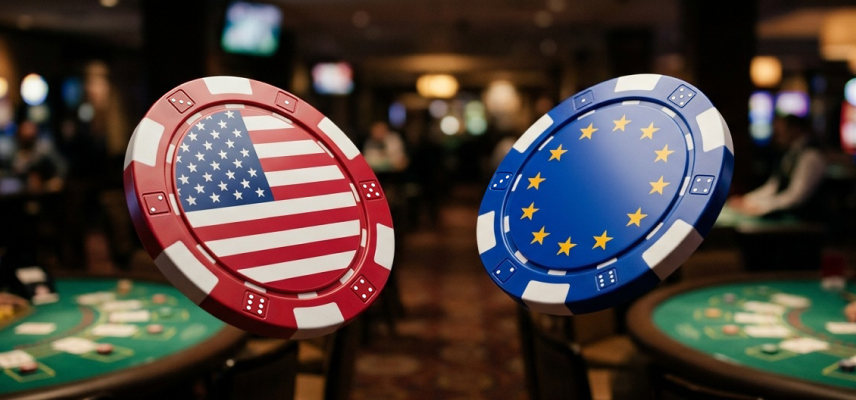
One concealed card changes how an entire blackjack round should be played. Under the standard American variation of the game, the dealer receives a face-down hole card and can check for a natural blackjack before players double or split. Under the European no-hole-card model, the dealer normally takes a second card only after every player has acted. That change, although it may seem minor, is the central difference between European and American blackjack, since extra wagers may already be on the table when a dealer blackjack is revealed.


At our online casino, the type of game, whether it be European or American, can give users an insight into the title, but it does not act as a complete rule confirmation. Deck count, blackjack payout, soft-17 rules, and permitted actions can still differ by title. Open the information tab before betting on any live blackjack casino games, and consider using a strategy chart built for that exact combination, which can help you to make the mathematically optimal decision in all scenarios.
The Defining Difference: To Peek or Not to Peek?
Before any player hits, stands, doubles, or splits, check how many dealer cards are dealt. A face-down second card allows an immediate blackjack check when the upcard is an ace or a ten-value card. With one dealer card visible and no second card yet dealt, that check cannot happen. Players must finish their hands first, so the potential financial effect reaches beyond what anyone can see on the layout.
Of course, this change does not alter the objective. You still try to beat the dealer without exceeding 21, and a two-card ace plus a ten-value card is a natural blackjack. What changes is the point at which the dealer can confirm the same result.
American Blackjack (The Hole Card Game)
Two dealer cards are placed at the start, one face up and one face down. In a conventional American blackjack game, an ace or ten-value upcard prompts the dealer or software to check the hole card before normal player decisions continue. If the dealer has blackjack, the round is settled immediately, so players do not place later double-down or split wagers against an already completed natural blackjack from the dealer.
Insurance may be offered when the dealer shows an ace. It is a separate wager, normally limited to half the original stake, that pays 2:1 if the dealer has blackjack. The payout does not make insurance part of standard basic strategy for an ordinary player because its value depends on whether the unseen cards make a ten-value hole card sufficiently likely.
American tables often permit more player actions as well, although the format alone guarantees none of them. Common versions allow doubling on any first two cards, doubling after a split, more than one split, and late surrender. Some stand on soft 17, while others require the dealer to hit it, and natural blackjack payouts can also be 3:2 or 6:5, a difference that deserves attention before the first wager is placed.
European Blackjack (The No-Peek Game)
In this variation of the game, only the upcard is dealt initially, and once player hands are completed, the dealer receives the second card and checks the final total, including whether or not those two cards form a blackjack. This answers what is European blackjack at its most useful level, as it involves a no-hole-card format, usually paired with tighter doubling and splitting options.
Traditional European blackjack rules often use two decks and require the dealer to stand on soft 17. They may permit doubles only on hard totals from 9 through 11 and restrict players to one split, with doubling after a split also typically being restricted.
Full-loss European no-hole-card rules create the main strategic complication because if the dealer later reveals blackjack, the original wager and additional money committed through doubling or splitting can all lose. Some tables instead use an original-bets-only rule, also known as OBO. Under this settlement rule, a dealer blackjack takes only the initial wager rather than the additional amounts committed through doubling or splitting. This should be checked before playing because OBO is not guaranteed at every European table, although it is a rule that is favourable to players.
The Ultimate American vs. European Comparison Table
The type of table can guide you in the right direction, but the individual rules determine the correct decision chart for players to use. Here’s a look at some of the key points to evaluate when choosing from our live casino games catalogue:
| Rule | Typical American Version | Typical European Version |
| Dealer’s initial cards | One upcard and one hole card | One upcard with the second card dealt later |
| Blackjack check | Usually checks under an ace or ten-value upcard | No early checks because no hole card exists yet |
| Exposure to dealer blackjack | Extra split and double wagers are not placed after a successful peek | Extra wagers may lose unless the OBO rule applies |
| Decks | Commonly, six or eight decks are used | Two decks are often in play |
| Doubling | Often allowed on any first two cards | Usually limited to hard totals from 9 to 11 |
| Doubling after a split | Usually permitted | Often not allowed |
| Splitting | Resplitting may be offered | Players are normally limited to one split |
| Natural payout | 3:2 or 6:5, with the first being the better option | Commonly 3:2 |
| Soft 17 | Dealer may stand or hit | Dealer commonly stands on this total |
Of course, you shouldn’t just consider one of these factors when deciding what to play, as a two-deck European game can stop players from doubling on certain hands, while a six-deck American table may award less for a natural blackjack. All of the different things above should be looked at before placing chips.
Doubling Down and Splitting: The Hidden Restrictions
Additional chips enter the round with both of these actions. As the name suggests, doubling normally involves adding an amount equal to the original wager in return for exactly one more card, at which point the hand stands, while splitting places another equal wager and separates the starting pair into two separate hands. The permitted totals, pair definitions, post-split options, and hand limits are set by the table, not the format itself.
Under a typical American ruleset, a player might double any initial two-card total and double again after splitting a pair. Resplitting can create further hands, up to a specific limit. Split aces usually receive only one additional card each, and a two-card 21 produced after a split is normally treated as an ordinary 21 rather than a natural blackjack.
European restrictions reduce the number of choices available to those at the table. If doubling is confined to hard 9 through 11, soft hands such as ace-7 cannot be doubled even where a different chart recommends it. A one-split limit prevents a newly dealt matching card from being separated again, while a no-double-after-split rule removes the option to increase a strong post-split hand. Each restriction changes expected return slightly, and several can apply together.
Before using either action, confirm these four things:
- Whether dealer blackjack takes every wager or only the original bet.
- Which two-card totals qualify for doubling.
- Whether doubling remains available after a split.
- How many hands may be created, including any special rule for aces.
Another thing that helps here is bankroll management, as starting with a $20 wager can require another $20 for a double, while one split also requires players to increase their bet by $20. Further permitted splits increase the total bet for the round again, so set the initial wager with those possible additions in mind.
How European Rules Force You to Change Your Strategy

Switching strategy charts without taking the full rules into consideration is a mistake that some players fall into. European blackjack strategy must account for the delayed dealer card, restricted actions, soft-17 procedure, and the exact loss rule if the dealer forms a natural. Most hit and stand choices against dealer upcards from 2 through 9 remain driven by the same total-versus-upcard calculation, but how each hand can be played changes.
Without OBO, European blackjack basic strategy can discourage additional wagers when the dealer shows an ace or a ten because a later dealer blackjack can take the extra double or split stakes.
The “Double Down” Danger
Against lower dealer upcards, optimal doubles may remain unchanged. The warning applies most sharply when the dealer shows ten or ace, and the table takes all additional wagers after a blackjack. For example, hard 11 against a dealer 10 is commonly doubled in a multi-deck peek game, but a full-loss no-hole-card chart commonly calls for a hit instead.
With that being said, dealer soft-17 rules, deck count, permitted double totals, and surrender availability can alter these decisions from an optimal standpoint. To find the correct action, identify whether OBO applies, select the matching chart, confirm the remaining rules, and then locate your hand against the dealer’s upcard.
To Split or Not to Split
Pairs expose two wagers rather than one, so the dealer’s potential of having a natural blackjack matters. For example, if the player has a pair of eights against a dealer 10, a conventional peek-game chart commonly splits them, but without OBO present, the matching chart commonly hits because both split wagers would be at risk, should the dealer draw an ace as their second card. Pair aces against a dealer ace can lead to another change in strategy under full-loss rules.
House Edge and Odds: Which Game is Actually Better?
There is no outright better option for players, as each format has rules that can either increase or decrease the house edge. American rules gain value from the early peek, broader doubles, possible resplitting, and late surrender where offered, while European tables may counter with fewer decks, a dealer who stands on soft 17, a 3:2 natural payout, and OBO protection. Either game can become the worse option if its other rules are less favourable.
Besides checking the game’s RTP, compare the blackjack payout directly. On a $20 natural, 3:2 produces $30 in profit, while 6:5 produces $24, and while this $6 gap seems minimal, it applies every time the player receives a natural blackjack. As a result, a flexible American game offering 6:5 can be mathematically worse than a more restrictive European table paying 3:2.
Next, inspect the complete rules of the title without just relying on the RTP figure:
- Prefer 3:2 blackjack over 6:5 when the remaining conditions are comparable.
- Check whether the dealer stands or hits on soft 17.
- Identify ENHC full-loss or OBO treatment before doubling against high upcards.
- Match the strategy chart to deck count, double rules, splitting rules, and surrender.
It’s worth mentioning that correct basic strategy reduces avoidable decision errors, but it cannot remove the house edge or guarantee a winning session. Short-run results can move far from the theoretical average, even with every action selected correctly. At ToonieBet, use the information panel to compare the exact rules, then choose stakes that fit a fixed entertainment budget. The same is true when playing other games, such as live roulette or live baccarat.
FAQ
1 Can I Use One Basic Strategy Chart for Both Versions?
No, a chart built for an American peek game can recommend doubles or splits that expose extra chips under full-loss rules in European alternatives. Use a chart whose deck count, soft-17 rule, doubling conditions, and hole-card treatment match the selected table.
2 Does European Blackjack Always Use Two Decks?
Two decks are common in the traditional version, but the game name does not guarantee that number.
3 What Happens If the Dealer Gets Blackjack After I Double?
Full-loss ENHC can take both the original wager and the additional double amount. Under OBO, the added portion is returned, and only the original stake is lost. A player natural generally pushes against a dealer natural, but rules can change so double-check before you start.
4 Is American Blackjack Automatically Better?
No, its peek can protect additional wagers, but payout, soft-17 treatment, action restrictions, and hole-card policy determine the full house edge.
5 Where Can Players Compare Blackjack Tables?
Our live casino catalogue features dealer-led blackjack titles and their individual information panels. Read the rules before entering because similarly named tables can use different limits or side bets. Players must be at least 19 and physically located in Canada to wager. Set a session budget before joining any table to ensure responsible play.
The content is provided for general informational and entertainment purposes only and does not constitute betting advice, financial advice, or a recommendation to place any wager. Odds are subject to change. Sports wagering involves risk, and there is no guarantee of success or profit. For Ontario residents, participation in regulated online gaming is restricted to individuals 19 years of age or older. Please play responsibly. If gambling is no longer fun or may be causing harm, support is available through recognized gambling resources like ConnexOntario. Terms and conditions apply where applicable.
