



How to bet on tennis: Your guide to aces instead of double faults
When it comes to betting, few sports match the non-stop, year-round excitement of the tennis calendar, thanks to the pure head-to-head battles. There are no clocks to run out and no ties to muddy the waters. Every match produces a clear winner and loser.


Learning how to bet on tennis effectively requires more than just knowing who’s at the top of the world rankings. Tennis features distinct playing surfaces, varying tournament formats, rapid psychological swings and complex sportsbook rules that can catch novice bettors off guard. Whether you’re stepping into sports betting ontario for the first time or looking to sharpen your long-term handicapping edge, this guide breaks down everything you need to know to bet smarter on both the men’s and women’s tours.
Table of Contents
Tennis betting rules for beginners
Before placing a single dollar on an ATP or WTA match, you must understand tennis rules and how sportsbooks interpret them. A fundamental question for newcomers is: how does tennis betting work when a match doesn’t go according to script? Unlike team sports, a tennis match can end early due to injury, illness or disqualification.
The walkover and retirement trap
One of the most critical aspects to tennis betting is understanding your sportsbook’s rules around retirements and walkovers. If a player withdraws before stepping onto the court, it is called a walkover. In almost every sportsbook, bets placed on a match that ends in a walkover are voided and your money is refunded.
However, if a match begins and a player retires in the second set due to a twisted ankle or heat exhaustion, how your bet is graded depends entirely on the specific rules of the sportsbook. Most operators fall into one of three categories:
- One-ball rule: As long as one point has been played, moneyline bets stand. The player advancing to the next round is declared the winner.
- One-set rule: At least one full set must be completed for moneyline bets to stand. If a player retires at 3-2 in the first set, all bets are void.
- Match-completion rule: The match must be played to its natural conclusion. Any retirement at any stage results in voided bets and refunded money.
Always check these rules before building your tennis betting strategy.
At ToonieBet, the match must be completed for markets to be graded. The exception is markets that would be automatically decided if the match was played to its natural conclusion. For example: The total games line is 20.5 and the score is 6-4 and 5-5 when a player retires; the over would settle as a win since the bet would have won if the player hadn’t retired.
Different tournaments have different formats
Understanding the scoring format of the specific tournament you’re betting on is essential. While the standard scoring progression of 15, 30, 40, game remains constant, set formats change depending on the gender and the prestige of the event.
In all WTA events and standard ATP events (Masters 1000, ATP 500 and ATP 250 tournaments), matches are played as a best-of-three sets. To win the match, a player must win two sets. However, in the four Grand Slam tournaments (the Australian Open, French Open, Wimbledon and the US Open), the ATP men compete in a best-of-five format, while the women remain at best-of-three.
This drastically alters how you should approach handicap betting and totals. A slow starter on the regular men’s tour might regularly drop the first set in a Grand Slam before rallying to win 3-1 or 3-2, offering tremendous live betting value that simply doesn’t exist in a shorter best-of-three format.

Tennis betting markets explained
Match moneyline
The match moneyline is the simplest and most popular bet in tennis. It’s purely betting on the winner, regardless of the score or how long it takes.
If you see a player listed at -200 (1.50 in decimal odds), they’re the favourite. You’d need to wager $200 to win $100 in profit. Conversely, an underdog listed at +175 (2.75) would return $170.50 in profit on a $100 bet if they pull off the upset.
Set and game spreads
Because early rounds in tennis often match elite players against lower-ranked qualifiers, moneyline odds on favourites can be really short. To find value, bettors turn to spread betting, which handicaps the match by games or sets.
- Game spread: If a favourite is -4.5 games, they must win five more total games than their opponent during the entire match for your bet to cash. For example, if the favourite wins 6-4, 6-3, they won 12 games while the underdog won seven. The five-game margin covers the -4.5 spread.
- Set spread: In a best-of-three match, betting a favourite at -1.5 sets means they must win the match in straight sets (2-0). Betting the underdog at +1.5 means you win if they win the match outright or simply win one set (losing 2-1).
Over/Under totals
Totals allow you to wager on the overall length and competitiveness of a match without having to predict the winner. Sportsbooks set a projected number of total games or sets, and you bet whether the actual result will go over or under that line.
If the total games line for a match is set at 21.5, a 6-4, 6-4 victory (20 total games) would cash the under. A tight 7-6, 6-4 contest (23 total games) would win the over.
Tennis futures
Futures markets most commonly involve picking the outright winner of a tournament before it begins or during the early rounds. You can find robust futures markets for all four Grand Slams, year-end championships and major tour events.
| BETTING MARKET | YOU’RE BETTING | RISK LEVEL |
| Moneyline | Outright match winner | Low to Moderate |
| Game Spread (-3.5 / +3.5) | Margin of victory by total games won | Moderate |
| Set Spread (-1.5 / +1.5) | Straight sets or not | Moderate |
| Total Games (Over/Under) | How many games both players will combine to win | Moderate |
| Tournament Futures | The outright winner of a tournament | High |
The rise of live and prop betting
As sports wagering technology has evolved, how to bet on tennis matches has shifted dramatically from pre-match analysis to real-time execution. Because tennis is naturally broken down into distinct points, games and sets, it’s arguably the best sport in the world forlive sports betting.
Next game winner
Instead of waiting hours for a match to conclude, you can wager on who will win the very next game. Because serving is such a massive advantage in modern tennis, the server is almost always heavily favoured to win their service game. The real value comes when you identify a server who is struggling with first-serve percentage or facing a wind disadvantage, allowing you to back the returner at attractive plus-money odds to break.
Exact set score
If you have a strong read on how a match will play out, betting the exact score of a set (e.g., 6-2, 6-3 or 7-5) offers generous payouts. This market requires a deep understanding of service dominance and return efficiency. When two elite servers clash on a fast surface, backing a 7-6 set score (meaning the set goes to a tiebreak) is a staple strategy for experienced bettors.
Point-by-point micro betting
For bettors who want rapid-fire action, micro betting allows you to wager on individual points. You can bet on whether the next point will be an ace, a double fault, a winner or an unforced error. While fun and engaging, micro betting requires strict discipline and a keen eye for physical cues, such as a player reaching for their shoulder or visibly tiring during a long rally.
How court types change the game
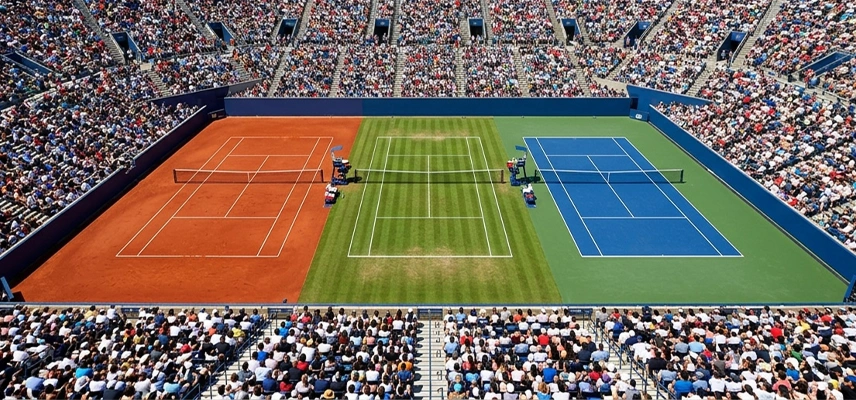
One of the most valuable tennis betting tips you’ll ever get is: Never treat tennis as a uniform sport. A Top-10 player on one surface can easily lose to a player ranked outside the Top 50 on another. Pro tennis is played on three surfaces, each featuring distinct physical characteristics that reward entirely different styles of play.
Clay
Most notably featured at the French Open, clay courts are the slowest in tennis. The crushed brick absorbs the impact of the ball, causing it to bounce significantly higher and slower than on other surfaces.
That neutralizes big servers and heavily favours aggressive baseliners who possess elite stamina, heavy topspin and the ability to slide into their shots. When betting on clay matches, prioritize players with high break-point conversion rates and superior physical fitness over pure power hitters.
Grass
At the opposite end of the spectrum lies grass, the traditional surface of Wimbledon. Grass courts are the fastest surface in tennis. The ball skids off the natural turf, resulting in a very low, unpredictable bounce.
Grass heavily favours aggressive, flat hitters and players with massive first serves. Rallies are generally short, breaks of serve are rare and tiebreaks are frequent. When handicapping grass-court matches, look for players who hold serve at an elite percentage and avoid defensive baseliners who need time to set up their groundstrokes.
Hard courts
Hard courts, used at the Australian Open, the US Open and the majority of tour events, serve as the great equalizer in tennis. Built from synthetic layers over concrete or asphalt, hard courts offer a true, predictable bounce at a medium-to-fast pace.
While big servers still hold an advantage, well-rounded players who can defend well and transition quickly into offence thrive here by combining exceptional return skills with relentless baseline consistency.
Advanced metrics
If you want to move past casual wagering and develop a winning tennis betting strategy, you must look beyond basic win-loss records and official rankings. Relying on underlying performance metrics helps to uncover value before the betting lines adjust.
Hold/break percentage
A player’s combined hold and break percentage is the single most reliable indicator of their true hard-court and clay-court abilities.
- Hold percentage: The frequency a player wins their own service games. Elite ATP players routinely hold serve at 85% or more, while top WTA players generally hover between 70% and 80%.
- Break percentage: How often a player breaks their opponent’s serve.
If you find an unseeded player with an 82% hold percentage and a 25% break percentage over a three-month span, the 107 combined score shows they’re performing at a Top-15 level, regardless of their official ranking. Backing such undervalued players on the moneyline or game spread is a proven long-term strategy.
Break point conversion and saved rates
Tennis is a game of margins, and matches are often decided by just two or three critical points. However, break point conversion (the percentage of break opportunities a player successfully converts) and break points saved can be heavily influenced by short-term luck and variance.
If a player is riding a six-match winning streak where they’ve saved 90% of break points against, that’s a statistical anomaly that’s impossible to maintain. They’re a prime candidate for regression. Betting against them in their next match is a smart analytical play.
Fatigue and travel
The professional tennis circuit is a gruelling global roadshow that jumps across time zones, continents and climates on a weekly basis. Unlike major team sports that use chartered jets with dedicated medical staffs, tennis players manage their own travel logistics.
Always track a player’s recent workload before laying your money down. A player who just reached the final of a tournament on Sunday in Europe, only to fly across the Atlantic to play a first-round match in North America on Tuesday is at a massive disadvantage, charter flights and entourages or no. Targeting fresh underdogs against travel-weary favourites is a reliable angle throughout the spring and autumn hard-court swings.
Live betting tennis

Tennis is an intensely psychological sport. Because players are isolated on the court without coaches, momentum can shift in the blink of an eye. Mastering live betting requires identifying psychological tipping points before the oddsmakers adjust the lines.
The “Bounce Back” factor
One of the most reliable phenomena in tennis, particularly on the WTA tour, where serving dominance is less pronounced, is the immediate break back. When a player works tirelessly to break their opponent’s serve, they often experience a fleeting subconscious relaxation the very next game.
Simultaneously, the player who just lost their serve often plays with desperate aggression. If you watch a favourite get broken early in a set, checking the live lines to bet them to break back immediately often yields lucrative odds.
The letdown game
Another common psychological hurdle occurs immediately after a player wins a high-stress tiebreak or a dramatic 7-5 set. The emotional energy spent clinching a tight set often leads to an unconscious drop in intensity to start the following set. Savvy live bettors frequently target the loser of a tight first set to bounce back and secure an early break in the opening games of the second set.
Smart bankroll management
Even the most sophisticated handicapping models will fail without disciplined bankroll management. Because tennis features heavy favourites and volatile momentum swings, protecting your money is essential for long-term gain. Whether you’re placing a calculated sports wager or stepping away to enjoy games at an online casino ontario, maintaining strict financial discipline should always be your top priority.
ToonieBet has a suite of responsible gaming tools to help you do just that, including deposit, loss and session limits. Remember, online gaming is a form of entertainment and should be treated as such. If you’re obsessing over your bets, take a break and just enjoy the sport for what it is.
Avoiding the parlay pitfall
One of the biggest leaks for casual sports bettors during Grand Slam tournaments is the massive favourite parlay. Bettors will string together seven or eight top seeds listed at -1000 or -800 moneyline odds, assuming that a top-ranked professional could never lose to an unknown qualifier in the first round of Wimbledon or the US Open.
In reality, backing massive favourites in multi-leg parlays offers terrible value. All it takes is one player waking up with a stiff back, running into a hot opponent or twisting an ankle on a slippery court to destroy an eight-leg parlay that was only paying even money to begin with. Instead of parlaying heavy moneylines, look for value in single bets on game spreads or set totals.
Flat betting vs. unit system
To survive the natural variance of sports betting, establish a clear betting plan based on units. A single unit should represent between 1% and 3% of your total dedicated betting bankroll.
- Flat betting: You wager exactly one unit on every single bet you place, regardless of your confidence level or the odds. This is the safest approach for beginners because it prevents emotional chasing after a losing streak.
- Percentage/Unit scaling: Experienced bettors may scale their bets between one and three units based on perceived edge and mathematical value. However, you should never wager more than 5% of your bankroll on a single tennis match, no matter how much of a “sure thing” it appears to be.
| Feature image courtesy AP Photo/Kin Cheung via Canadian Press Images. |
1 What happens to my bet if a tennis player retires injured?
That depends entirely on a sportsbook’s specific house rules. Some require just a single ball to be served for moneyline bets to stand, awarding the win to the player who advances. Others require at least one full set to be completed, while some require the match to finish naturally, otherwise voiding all bets and refunding bettors.
2 Is it better to bet on the ATP or WTA?
Neither tour is inherently better, but they offer distinct betting dynamics. The ATP is heavily dominated by holding serve, making total over/under bets and tiebreak props very popular. The WTA features more breaks of serve and volatile momentum swings, which often creates superior value for live underdog betting and spread wagering.
3 How do court surfaces affect tennis odds?
Court surfaces drastically alter match dynamics. Slow clay courts favour defensive baseliners with heavy topspin and elite stamina, often neutralizing powerful servers. Fast grass courts reward big servers and flat hitters. Hard courts offer a neutral medium pace where well-rounded, adaptable players thrive. Oddsmakers adjust lines based on surface history, but finding players whose styles excel on specific surfaces is a great source of betting value.
4 What is the most profitable tennis bet for beginners?
For beginners, wagering on the game spread or match totals (over/under total games) is generally more profitable and less volatile than betting moneylines or parlays. Spread betting allows you to back an underdog to keep a match competitive without needing them to pull off an outright upset, while totals allow you to wager on the general pace and competitiveness of the match based on serving dynamics.
5 Why do tennis odds change so quickly during live betting?
Tennis is a point-by-point sport where a single break of serve can completely alter the mathematical probability of winning a set or match. Because there is no game clock and scoring occurs every few seconds, trading algorithms and oddsmakers must continuously adjust live lines after every point to reflect the shifting probabilities and momentum on the court.
The content is provided for general informational and entertainment purposes only and does not constitute betting advice, financial advice, or a recommendation to place any wager. Odds are subject to change. Sports wagering involves risk, and there is no guarantee of success or profit. For Ontario residents, participation in regulated online gaming is restricted to individuals 19 years of age or older. Please play responsibly. If gambling is no longer fun or may be causing harm, support is available through recognized gambling resources like ConnexOntario. Terms and conditions apply where applicable.
