



How to bet on golf: Markets, odds, stats and strategies
Just about every week of the year, there’s professional golf going on somewhere with a sizable field of 50 to 156 competitors all looking to be crowned tournament champion. That means no matter the time of year, there’s almost always some golf to bet on, which helps make it one of the most popular sports among bettors.


That’s often because the odds for any single golfer to win are so long that even runaway favourites pay big. In April 2026 when Rory McIlroy teed off at The Masters as the defending champion his odds to win were roughly +1000, meaning a $100 bet would win the original $100 back plus an additional $1,000. While it’s tough to predict any winner week to week in golf, it almost always pays out big when you do.
While the PGA Tour is the most famous golf tour, it’s certainly not the only one available for sports betting: upstart LIV Golf, the DP World Tour, the LPGA, the Korn Ferry Tour, the majors and semi-annual competitions like the Ryder Cup, Presidents Cup and Solheim Cup all give bettors a chance to wager.
There really is a world of golf to bet on and ToonieBet has odds on it all.
This golf betting guide explains how to bet golf online by taking you through the main markets and odds, important statistics to research, how to bet golf live, current form vs. course history and more.
Consider this your home for online golf betting tips.
Table of Contents
Top golf markets and betting odds explained
Winner/Outright
As simple as it sounds, the Winner market is the most popular market in golf betting because it allows you to back an individual golfer to win any given tournament.
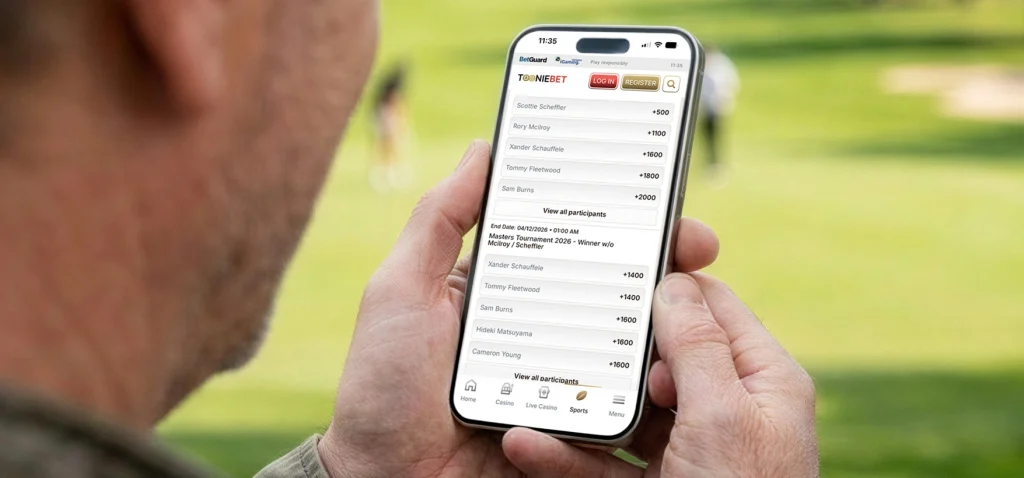
Due to the aforementioned size of the fields, you’ll typically find very juicy odds, with the favourites in full field events (think Scottie Scheffler or Rory McIlroy at the Masters) in the +500 to +1000 range. After the “big guns” you’ll find massive odds on virtually everyone else to reflect the rarity of a win in fields with 100 or more competitors!
Winner Without X
As an added bonus when there is a significant favourite or two in the field, sportsbooks will occasionally offer the “Winner without X” market.
Here’s how it works: Let’s say Jon Rahm is playing and is +800 to win, while the next shortest odds are Tyrell Hatton at +1500. ToonieBet may offer a “Winner without Rahm” market, which would make Hatton the new favourite for this market. That means the bet would win if (a) Hatton beats Rahm and wins the whole event, or (b) Rahm wins and Hatton finishes second.
Of course, this means shorter odds (but not that short because… golf), but you essentially get the opportunity to bet the tournament without the glaring favourite to worry about.
Double Chance
The Double Chance market essentially allows you to bet a combination of golfers on the Outright. So, if Collin Morikawa is the favourite and Xander Schauffele has the next best odds, the favourite in the Double Chance market would be “Collin Morikawa Or Xander Schauffele”, meaning if either player wins the tournament your bet also wins.
Top Finish
Similar to the Winner market, this is a very-easy-to-follow option that is graded based on the final standings of any given tournament.
For example, if you bet Cameron Young Top 5 and he finishes third, your bet wins. Odds will of course be shorter than the Winner/Outright, but offer much more flexibility in terms of how well the selection needs to play in order to pay out.
One important caveat when analyzing this market is checking whether or not it includes ties. If you bet on a Top 20 (with ties), then your golfer can finish tied for 20th with any number of golfers and still be graded a full winner. If you bet without ties (or “dead heat”), a golfer who lands on the hook line (i.e. 5th for Top 5, 10th for Top 10, etc.) will be subject to dead heat grading rules. In a “Dead Heat”, the money wagered on a selection is divided by the number of runners involved in the dead heat.
So for instance, if you bet Cameron Young Top 5 for $10 at +200 odds, and one other golfer ties him for 5th, your wager is reduced by 50%. As such, the bet is now treated as $5 at +200, meaning that your payout would be $15 ($5 stake at +200 odds for $10 profit = $15) instead of $30 ($10 stake at +200 for $20 profit = $30).
Each Way
An Each-Way (E/W) bet splits your total wager into two separate bets: an outright win and the golfer to finish near the top of the leaderboard.
How E/W bets work
When you place an E/W bet, your total wager is doubled, i.e. a $10 each-way bet actually costs $20 ($10 for the win, $10 for the place).
- Win:Half your money goes toward the winning golfer. If they finish 2nd or worse, this half of the bet loses.
- Place:The other half goes toward the golfer finishing within a predetermined number of spots (usually the Top 5, 6, or 8). If they finish in that range, you’re paid out at a fraction of their outright odds (usually 1/4 or 1/5 of the original odds).
How E/W math works
Let’s say you place a $10 Each-Way bet on Nelly Korda at +2000 odds.
- Total bet: $20 ($10 to win, $10 to place)
- Place terms: Top 5 finish at 1/4 of the outright odds (20 divided by 4 = +500)
Here is how the payouts break down based on her finish:
| RESULT | WIN OUTCOME | PLACE OUTCOME | PAYOUT | Net Profit / Loss |
| Korda 1st | $200 (+ $10 original bet) | $50 (+ $10 original bet) | $270 | + $250 |
| Korda 3rd | Loses (-$10) | $50 (+ $10 original bet) | $60 | + $40 |
| Korda 15th | Loses (-$10) | Loses (-$10) | $0 | – $20 |
Make sure you know how your sportsbook handles Dead Heats. If Korda finished T-3 with three others, that means there are four golfers in the 3rd, 4th, 5th and 6th spots. Because three of those players fall in the Top 5, the sportsbook will reduce your winnings.
H2H/2-Ball/3-Ball/Match Betting
For those more interested in traditional betting formats, sportsbooks will typically offer the option to back golfers in either a two-way or three-way moneyline depending on the situation. Ahead of tournaments you can typically find H2H offerings between two golfers, with the winner being determined by who finishes the tournament with a lower score.
Similarly, when tee times are released you’ll be able to bet on playing partners (typically groups of two or three) and who you think will perform the best that round. One key note here is that you’ll likely be able to bet with or without ties, with ties having an additional selection to bet on a Draw (meaning they finish with the same score) and without, meaning that a draw ends in a push and wagers are refunded.
Round-by-Round Props
Round markets (especially for Round 1) offer bettors quicker propositions as opposed to the Winner/Outright market. The same markets you’d find for the full tournament are duplicated for each round, such as the Round Winner (or Round X Leader), Top-X in Round X, etc. These markets take place over a single round as opposed to the full tournament.
You’ll typically find longer odds on the favourites to emerge victorious and shorter odds on long shots to come out ahead. That’s because as the number of holes is reduced from 72 to 18, the variance is reduced, pulling everyone closer to the mean. One important note for bets after Round 1 is to be aware if you’re betting on performance specifically in that round or their cumulative score from all rounds completed so far.
Golf betting cheat sheet
| MARKET | MARKET EXPLAINED | RISK |
| Outright Winner | Picking the tournament winner. | Very High |
| Top 5 / 10 / 20 | Betting a golfer to finish in the Top 5, 10, or 20. | Medium |
| Each-Way | Two bets in one: half to win, half to place (finish near the top). | High |
| 2-Ball / 3-Ball | Betting a golfer to shoot a lower score than their group partners. | Low |
| Make / Miss Cut | Wagering if a golfer makes the 36-hole cut. | Low |
| First Round Leader (FRL) | Predicting the player with the lowest score after Round 1. | Very High |
| Group Betting | Picking the best scorer from a specific pool of 4-6 golfers. | Medium |
| Hole-in-One | Betting if anyone will have a hole-in-one during the event. | High |
| Winning Margin | Predicting the exact number of strokes the champion wins by. | High |
Advanced analytics: “Strokes Gained” explained
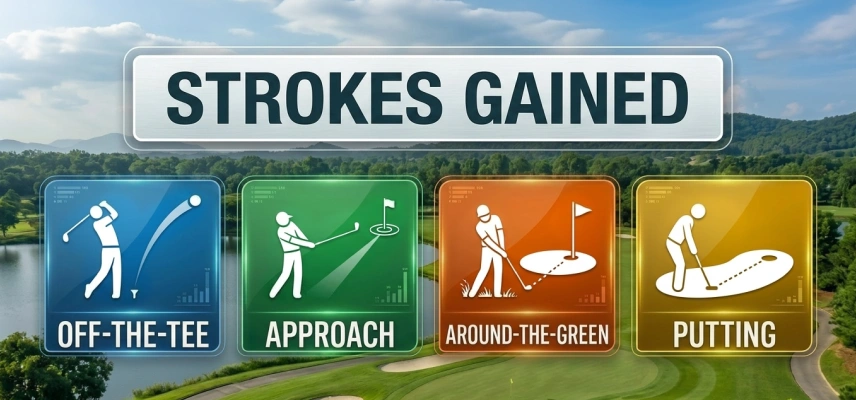
Strokes Gained(SG) is the most important metric in golf betting because it measures a player’s performance against the rest of the field from any specific distance and lie on the course. More strokes gained = better performance.
To properly handicap a golf tournament, you must understand how a player builds their score. Here’s a breakdown of the four major Strokes Gained categories used by professional bettors:
Strokes Gained: Off-the-Tee (SG: OTT)
This metric evaluates a player’s performance on their first shot on all Par 4s and 5s. It blends driving distance and accuracy into one number. Golfers who hit the ball long and hit the fairway gain a massive statistical advantage over those hacking out of the rough, making elite drivers incredibly valuable at long, penal golf courses.
Strokes Gained: Approach (SG: APP)
The holy grail of golf betting analytics measures all shots taken 30 yards or more from the green, including Par 3 tee shots, to isolate a golfer’s iron and wedge play. Because elite approach play is the most predictive metric for future tournament success, bettors heavily weight players who rank high in SG:APP when picking outright winners.
Strokes Gained: Around-the-Green (SG: ARG)
This category tracks any shot within 30 yards of the putting surface. It includes chipping from the fringe, pitching from the rough and greenside bunker play. Elite scramblers who thrive in SG: ARG are excellent targets when betting on difficult courses with firm conditions where players are expected to miss plenty of greens.
Strokes Gained: Putting (SG: PUTT)
This number shows exactly how many strokes a player saves or loses once they’re actually on the green, properly accounting for the distance of every putt. While you usually need a hot putter to win a golf tournament, putting is a notoriously volatile, mean-reverting metric. Savvy bettors avoid overvaluing a player based solely on a previous week’s putting performance, as it rarely guarantees sustained success.
How to use “strokes gained” to find betting value
- Target ball-strikers:Combining SG: OTT and SG: APP gives you a player’s total ball-striking profile. Because ball-striking is a highly repeatable skill, these players offer a significantly higher baseline for matchup and placement bets.
- Identify course fit: Different courses demand different skills. Use Strokes Gained data to align players with specific venues. If the tournament is held at a narrow course with thick rough, bump up players who excel in SG: OTT. If it is a short, strategic layout, prioritize SG: APP and SG: ARG.
- Spot positive regression candidates: Find down players who gained significant strokes from Tee-to-Green during their last tournament, but finished poorly because they lost an uncharacteristic amount of strokes on the greens. Because putting variance eventually balances out, these players are prime sleeper candidates whose outright odds are often mispriced by the books.
The key here is there’s no magical handbook that tells bettors what we need to be mindful of when betting — that is where personal research comes in. When deciding to place a bet, it’s best to look at what has historically succeeded at any individual course, and find a golfer who’s current form matches those attributes.
Course history vs. recent form when betting on golf

This is the eternal debate for every golf bettor. Player X is on fire recently, but has never had much success at Course Y or vice versa. What to do? Simply put, it’s often best to hedge your bets, but there are variables to take into account.
- Have the player’s Shot Gained metrics in categories specific to the course changed?
- Has the player had good results in the specific tournament in the past? (This is especially important at majors, where governing bodies tend to set courses up in similar ways year to year.)
- What wave are they in? Is Player X starting Round 1 in the morning or afternoon when the weather is projected to be calmer?
Live betting golf
Live betting allows us to place wagers on while the action is playing out on the course. That means we can capitalize on momentum shifts, course conditions and leaderboard changes. With rounds playing out over hours and tournaments taking days, golf has a lot of variables, which makes it a great sport to bet live.
How live golf betting works
Sportsbooks use sophisticated algorithms linked directly to tournament data. As a player hits a shot (good or bad), the odds update almost instantly to reflect their new probability of winning or scoring.
- Continuous updates: Odds are suspended for a few seconds while a player is standing over a meaningful shot and reopen with adjusted prices once the ball lands.
- Broadcast delays: The broadcast is usually 10 to 30 seconds behind the on-course action and networks soften how tape-delayed shots without telling the viewer. Sportsbook odds are generally faster than your TV or streaming feed.
- Hedging: Many bettors use live betting to guarantee a profit. If you bet a pre-tournament long shot at +5000 who takes a three-shot lead into Sunday, you can place live bets on the players trailing them (and in some cases, back “the field” against them) to reduce or completely erase your risk.
Popular live golf betting markets
| MARKET | HOW IT WORKS | RISK |
| Winner /Outright | Betting on who will win mid-event. Odds fluctuate based on leaderboard position and holes remaining. | High |
| Next Hole Score | Betting on if a specific player will make an Eagle, Birdie, Par or Bogey+ on the next hole. | Very High |
| Live Matchups | Betting on one golfer to outscore another for the remainder of the round. | Medium |
| Make / Miss the Cut | Betting during Round 2. A single dropped shot can completely swing the odds. | High |
| End of Round Leader | Betting on who will be the tournament leader when play ends for the day. There can be good value if early starters post a low number. | Medium |
Key strategies for live betting on golf
- Capitalize on course routing: Know how holes are ranked in difficulty. If the tournament leader is about to play a brutal three-hole stretch (like Amen Corner at The Masters), their odds to win might be inflated. You can wait for them to drop a shot to get a better price, or bet on a trailing player who is entering an easier stretch.
- Watch the weather: The elements make a huge difference. If wind or rain pick late in the afternoon, value can be found in betting on players who’ve finished their rounds.
- Look for elite ball-strikers with cold putters: If a top-tier player is hitting every fairway and green on Thursday but missing all their putts, they may be a great live bet. If their ball-striking remains steady, the putts should eventually drop and you can grab them at inflated live odds.
Golf betting resources
Now that we’ve covered the basics on what you can bet, how do we actually make decisions on what to wager on? For the PGA Tour a great place to start is its stats pages, which offer detailed player performance information by season, tournament and course covering entire careers. Additionally, you can find data ranking the toughest courses and holes by season, which can be even more important than a golfer’s form.
For more in-depth analysis, there are third-party providers like Betsperts Golf and Data Golf that offer paid subscriptions and in-depth analysis of golfers, courses and best fits for tournaments.
How to bet on golf
- Log in or register at ToonieBet.
- Navigate to the sportsbook > golf > tour.
- Bet on tournaments, rounds, players, or bet live.
How to live bet golf
- Navigate to the live sports page.
- Follow the tournament tracker for real-time odds and stats.

Golf betting FAQs
1 What happens to my bet if a golfer withdraws (WD) from a tournament?
For most sportsbooks, if you bet on a golfer and they withdraw before beginning their round, your bet is voided and your money is refunded. However, if the golfer hits their first tee shot and then withdraws at any point the bet is graded as a loss.
2 What is the "Dead Heat" rule in golf betting?
A dead heat occurs when multiple golfers tie for a position that you bet on, such as a Top finish. Because there are no tiebreakers for these placement positions, sportsbooks reduce the payout by dividing the bet by the number of players who tied.
3 How do Each-Way (E/W) bets work?
An each-way bet splits the wager into two parts: half goes toward the golfer winning the tournament outright and half toward them “placing” (usually Top 5, 6, or 8 depending on the sportsbook’s terms for that tournament).
If the golfer wins, you cash both bets. If the golfer places, the “win” portion is lost and the place portion wins. Remember that an each-way bet doubles the wager. A $10 E/W actually costs $20 total.
4 What is the difference between 2-ball and 3-ball betting in golf?
These are specific matchup bets where you wager on a golfer to shoot a lower score than their immediate playing partners for a single 18-hole round. 3-Ball is when players are grouped in threesomes, 2-Ball is when players are paired in twosomes.
5 Which statistics are the most important to research?
Strokes Gained analytics, which measure a player’s performance against the field average from specific distances. The two most predictive metrics for long-term tournament success are: Strokes Gained: Approach (SG: APP) and Strokes Gained: Tee-to-Green (SG: T2G).
| Feature image courtesy AP Photo/Matt Slocum via Canadian Press Images. Photo illustrations by Jacob Avers. |

The content is provided for general informational and entertainment purposes only and does not constitute betting advice, financial advice, or a recommendation to place any wager. Odds are subject to change. Sports wagering involves risk, and there is no guarantee of success or profit. For Ontario residents, participation in regulated online gaming is restricted to individuals 19 years of age or older. Please play responsibly. If gambling is no longer fun or may be causing harm, support is available through recognized gambling resources like ConnexOntario. Terms and conditions apply where applicable.
